/Brand/Logos/Kelly%20Partners%20Accountants%20Logo/Kelly-Partners-Accountants-Horizontal-Logo.webp?width=1500&height=212&name=Kelly-Partners-Accountants-Horizontal-Logo.webp "Kelly-Partners-Accountants-Horizontal-Logo")
/Brand/Logos/Kelly%20Partners%20Accountants%20Logo/Kelly-Partners-Accountants-Horizontal-Logo.webp?width=300&height=42&name=Kelly-Partners-Accountants-Horizontal-Logo.webp "Kelly-Partners-Accountants-Horizontal-Logo")

The Dunning-Kruger Effect: Implications for Business Owners
In the fast-paced world of entrepreneurship, confidence is often celebrated as an essential trait. Running a business requires a degree of boldness - the willingness to take risks and challenge the status quo. However, there is a subtle and dangerous boundary where healthy self-assurance crosses into misplaced certainty. In cognitive psychology, this phenomenon is known as the Dunning-Kruger effect.
For business owners, failing to account for this cognitive bias can mean the difference between sustainable growth and costly strategic failures.

What is the Dunning-Kruger Effect?
First formally described in 1999 by social psychologists David Dunning and Justin Kruger, the Dunning-Kruger effect is a cognitive bias in which individuals with low ability or expertise in a specific domain overestimate their own competence.
Core Concept: People who lack deep knowledge about a subject often lack the very tools and perspective needed to realize how little they actually know. They remain blind to their own blind spots.
Conversely, the effect also has a secondary dimension: genuine experts frequently underestimate their own relative expertise, assuming that tasks easy for them are equally straightforward for everyone else.
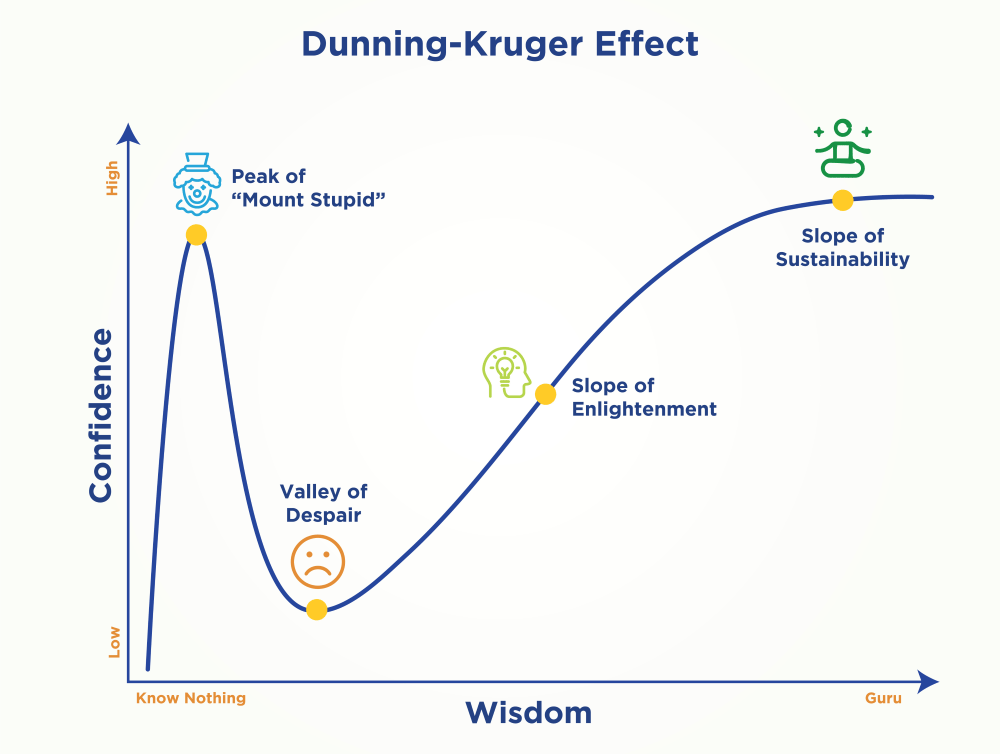
- The Peak of Ignorance: Beginners acquire a basic understanding of a topic and experience a dramatic spike in confidence, mistaking superficial familiarity for mastery.
- The Valley of Despair: As individuals learn more, they begin to grasp the vast complexity of the field, causing confidence to drop significantly.
- The Slope of Enlightenment: Through deliberate practice and deep learning, true competence builds alongside a realistic, grounded self-assessment.
Key Implications for Business Owners
When business owners operate under the influence of the Dunning-Kruger effect, the consequences ripple across every department - from strategic planning to organizational culture.
- Misallocation of Capital and Uncalculated Risks
Novice entrepreneurs or seasoned leaders stepping into unfamiliar territories (such as entering a new industry, scaling operations, or adopting complex technology like artificial intelligence) are particularly vulnerable.
Overestimating their understanding of market dynamics often leads to: launching products without sufficient market validation or consumer research, underfunding critical operational areas like legal compliance, supply chain management, or cybersecurity and pursuing aggressive expansion plans without the underlying infrastructure to support them. - Hiring the Loudest, Not the Most Capable
The bias impacts talent acquisition. Business owners who lack expertise in a specific area - such as software engineering or finance - struggle to evaluate job applicants effectively. They often hire candidates who speak with supreme confidence (often experiencing their own Dunning-Kruger peak) rather than quiet, highly skilled experts who offer nuanced, realistic assessments. - Dismissing Expert Counsel and Team Input
Founders who believe they possess comprehensive knowledge across all business functions are prone to hoarding decisions. They are more likely to ignore warnings from advisors, board members, or senior staff. This creates an environment where: Critical employee feedback is sidelined. Key talent feels undervalued and unmotivated, leading to high turnover. The business becomes brittle, reliant solely on the founder's limited perspective.
4. Resistance to Agility and Pivot Strategy
When market indicators signal that a business strategy is failing, leaders caught in this bias often mistake persistent failure for a temporary hurdle. Rather than re-evaluating their assumptions, they double down on flawed initiatives, burning through capital and valuable time.
How Business Owners Can Counteract the Bias
Recognizing that everyone is susceptible to the Dunning-Kruger effect in areas where they lack deep experience is the first step toward building a resilient business.
- Cultivate Metacognition (Thinking About Your Thinking)
Build a habit of questioning your own certainty. Ask yourself: "What evidence do I have to support this conclusion? What critical details might I be missing? "Rely on Objective Data Over Intuition: Ground strategic decisions in verifiable metrics, thorough competitor analysis, and external audits rather than relying purely on "gut feeling."
2. Establish a Culture of Psychological Safety:
Encourage team members to voice disagreement, highlight potential pitfalls, and challenge assumptions without fear of retaliation.
3. Build an Experienced Advisory Board
Surround yourself with specialists who hold deep expertise in areas outside your core strengths - and actively listen to their recommendations.
4. Reward Humility and Continuous Learning:
Model intellectual humility within your organisation by acknowledging what you do not know and celebrating continuous skill development across all levels.
The Dunning-Kruger effect is not a mark of poor intelligence; it is a fundamental bug in human cognition. For business owners, overcoming it does not mean losing decisiveness or enthusiasm.
Instead, it means pairing ambition with intellectual humility - recognizing where your expertise ends so you can empower others, make data-driven decisions, and lead your business toward durable success.
Share this

Mind Hacks for Everyone

Veterans in the Workforce