Australian & US Tax Specialists

USA Taxes for Aussies

We have US CPAs and Australian chartered accountants under one roof, so nothing gets lost between two advisers who have never met. One team looks at your super, your Australian house, your US pay and your business at the same time.

Book a discovery meeting
Get the Free US Tax Guide
Automotive-Repairers-Mobile
USA Tax Guide for Australians with Flags-1
usa-tax-for-aussies-two-tax-years

Two correct returns can still add up to the wrong answer.

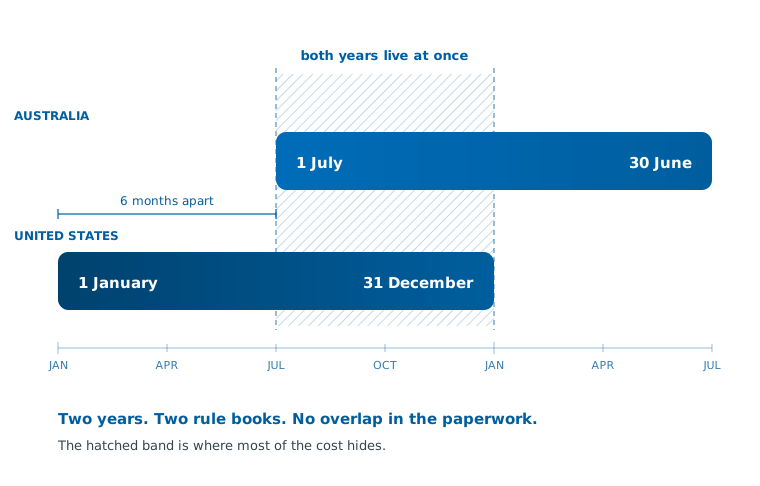
Australia's income year ends 30 June. America's ends 31 December. The two systems run on different calendars, ask different questions, and do not talk to each other. 

Your super, your Australian house and your US pay do not split neatly along either country's tax year. Nothing in your life does.

So most Australians end up with two returns that are each correct on their own and were never checked against one another. That is where the money goes.

US CPAs and Australian Chartered Accountants, one team

  Two separate firms Kelly+Partners
Who checks the two returns against each other? Nobody. Each is filed correctly in its own country and never compared with the other. We do, before either one is lodged.
Who spots what falls between them? You. You are the only person who has seen both files. Us. That is the job.
When do problems surface? Years later, once decisions have already been made. Early, while you can still change the answer.
What does it cost? Two sets of fees, and a six-month offset nobody is watching. Two clean files that talk to each other. Cheaper at year end.
How often do you hear from them? Once a year, twice over. Year-round, through both filing seasons.

Who We Help


Australians living in America

You are earning here, and Australia has not necessarily let go of you. These are the questions we work through first.

Is my super a foreign trust?
The honest answer is that it depends on your facts. Your visa, how much control you hold, and whose contributions went in all move the answer.

Do I still owe the ATO?
Residency is a test, not a postcode. You can look like a resident of both countries in one year, or neither.

What about the house we kept?
Keeping it puts the same income in front of two tax offices with two rule books.

Which accounts actually matter?
Usually the ones people forget. The joint account with your mum counts too.

Australian businesses in America

Setting up the wrong thing is harder to unwind than setting up nothing. Order matters more than speed.

Which structure, and in what order?
This decision follows you. It shapes your tax, your risk, and how easily you can sell the thing one day.

Where do we actually owe?
America is not one tax system. One employee in a new state can start a long list.

How do we pay ourselves?
Three ways to do it, three outcomes. Most people choose on autopilot and never do the sum both ways.

Getting profit home
Your US company made money. Bringing it back is a separate question from earning it.


Kelly+Partners Financial Progress System™

The Kelly+Partners Financial Progress System™ gives you structure, strategy, and clarity—so you can take control of your entire financial universe and make progress that lasts.

progress-system-place

1. Place

We start by identifying where you are today—then work with you to define clear goals for the next 5, 10, and 20 years.

progress-system-profile

2. Profile

We map your personal and business finances, wealth position, and succession needs to build a complete picture.

progress-system-plan

3. Plan

A tailored financial strategy is created to align with your objectives—ensuring structured, consistent progress.

progress-system-progress-1

4. Progress

We track your performance through regular reporting—monthly or quarterly—so you stay on course and in control.

FAQ


Is my superannuation taxed in the US?
It depends on your circumstances, and anyone who answers without asking about them is guessing. America has no equivalent of superannuation, so your fund has to be slotted into a US category — and which one it lands in changes the outcome significantly. The things that move the answer are your visa, how much control you hold over the fund, whether the contributions came from your employer or from you, and the treaty between the two countries. Get the category wrong and you can either report something you never needed to, or miss something you did. This is the single most common question we are asked, and the one most often handled incorrectly by a firm that only sees one country. 
Do I still have to lodge an Australian tax return after I move to the US?
Possibly, and for longer than most people expect. Leaving the country is not the same as leaving the tax system, and residency is a test rather than a postcode. Australia looks at where your life actually sits — your home, your family, your work, and how long you genuinely intend to be away — and it is a question of fact rather than something you elect. America then runs its own separate test on its own calendar. The two do not always agree, so you can look like a resident of both countries in the same year, or of neither. Australian-sourced income and Australian property can keep you lodging here regardless.
Which of my Australian accounts and assets do I need to report in the US?

More than most people expect, and the ones that cause trouble are usually the forgotten ones — an old savings account, a term deposit you stopped thinking about, or a joint account you share with a parent. Reporting obligations for Australians in America extend well beyond the accounts you would naturally describe as investments, and they sit separately from your tax return. The practical first step is to list every Australian account and asset with your name on it, including the ones you would never think to mention, and hand that list to someone who works across both systems.

We kept our house in Australia. How is it taxed now?

Renting out your Australian home from the US puts one lot of rental income in front of two tax offices that measure it differently, and both want to see it. Separately, what happens when you eventually sell depends on your residency position at the time you sell, which is why keep, rent or sell is a decision worth making deliberately rather than by default. The timing of that decision matters more than most people realise, and it is far cheaper to plan before you leave than to unpick afterwards. 

What happens to my Australian shares and managed funds?

If you kept them when you moved, this is one of the first things worth having looked at. Holdings that were completely sensible while you lived in Australia can be treated very differently once America is taxing you, and the difference is not obvious from the outside — it does not show up on your statement. Australian managed funds and ETFs in particular sit in a category the US treats unfavourably. It is considerably easier to deal with before the growth happens than after. 

Should my US business be an LLC or a corporation?

Not a question anyone should answer before seeing your Australian structure. The decision follows you: it shapes your tax on both sides, your risk, and how easily you can sell the business one day. An LLC is frequently the default American recommendation and frequently creates problems for Australian owners, because the two systems treat it differently. What actually goes wrong is rarely a single bad choice — it is choosing on autopilot and staying there for five years because nobody sat down and did the sum both ways. Setting up the wrong thing is harder to unwind than setting up nothing. 

Ready to get started?

It starts with a conversation. At Kelly+Partners, we deliver expert advice tailored to your personal, business, wealth, and estate needs—backed by structured systems and year-round support.

Book a discovery meeting
cta-icon